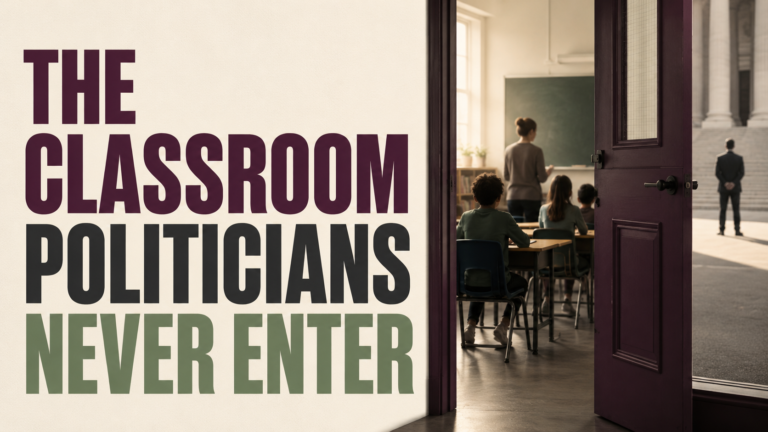
Teacher Bullying: How to Handle Workplace Disrespect

Being a teacher does not cancel your right to dignity.
I wish somebody had told me that much earlier in my career.
There were seasons when I tolerated things because I wanted to be seen as professional. I swallowed words. I avoided confrontation. I went home replaying conversations in my head. Sometimes, long after everyone else had moved on, I was still mentally reconstructing what I should have said.
I questioned myself after people spoke to me in ways they probably would never speak to professionals in many other industries.
And like many teachers, I sometimes confused endurance with maturity.
I thought perhaps a good teacher should simply absorb it.
The administrator humiliates you? Be professional.
A parent insults you? Remember that the parent is a stakeholder.
A student publicly disrespects you? Do not take it personally.
A colleague undermines you? Avoid workplace drama.
There is some wisdom in emotional control. But there is a dangerous point where emotional control becomes silent permission for people to continue violating your boundaries.
Professionalism does not mean becoming everybody’s punching bag.
That was one of the most important lessons I had to learn.
I did not need to become rude. I did not need to shout louder. I did not need to become combative.
I needed stronger boundaries.
Here is what that looked like for me.
1. When Administrators Disrespected Me, I Stopped Trying to Win Their Approval
I have worked under people who could make you feel incompetent without ever clearly telling you what you had done wrong.
Sometimes it was the tone.
Sometimes it was being corrected publicly.
Sometimes instructions changed, yet somehow I was still blamed for following yesterday’s instruction.
Sometimes somebody with a title appeared to believe that the title also gave them permission to speak to adults anyhow.
Earlier in my career, I responded the way many hardworking teachers respond.
I tried harder.
I came earlier. Stayed later. Accepted extra responsibilities. Volunteered for things nobody had asked me to do. Tried to make myself indispensable.
Somewhere inside me was the belief that if my work became excellent enough, excellence would eventually force everybody to respect me.
It did not always work.
I stopped making approval my professional scoreboard
The shift came when I stopped measuring my professional value through the mood of whoever happened to be above me.
I started documenting important instructions.
If a major decision was communicated verbally, I followed it with a polite written confirmation:
“Just to confirm our discussion today, I will proceed with…”
That habit protected me more than once.
It also changed the nature of difficult conversations.
Instead of arguing emotionally when criticised, I learnt to ask:
- What specifically would you like me to improve?
- What would successful performance look like here?
- Can we clarify the expectation going forward?
- What evidence are we using to assess this?
Those questions force the conversation to move away from personality and towards observable expectations.
I also learned to challenge public disrespect without creating public drama
When someone attempted to correct me disrespectfully in front of others, I learnt that I could say calmly:
“I’m happy to discuss the issue, but I would prefer that we discuss it privately.”
No shouting.
No performance.
No unnecessary war.
Just a boundary.
I also kept developing myself outside the institution.
I trained. I read. I wrote. I learnt technology. I expanded my network. I built skills that were not dependent on one school recognising my value.
That mattered enormously for my mental wellbeing because I stopped feeling trapped.
Sometimes one of the strongest responses to workplace bullying is knowing that your entire future is not sitting inside one principal’s office.
2. When Parents Disrespected Me, I Stopped Defending Myself Like an Accused Person
A parent can sometimes walk into a school already angry, and suddenly the teacher becomes the defendant before anyone has established what actually happened.
You may hear:
“Why did you do this to my child?”
“My child said…”
“You teachers always…”
Earlier in my career, my instinct was to explain everything immediately.
I wanted them to understand that I was not a bad teacher.
I wanted to correct every inaccurate detail.
I wanted to defend myself.
But I eventually realised that excessive explanation during an emotionally charged conversation can sound like desperation rather than clarity.
I started separating emotion from evidence
First, I let the parent speak.
Then I acknowledged the emotion without automatically admitting wrongdoing.
“I understand that you’re upset. Let me show you what happened from my side.”
Then I brought evidence wherever possible:
- The student’s work.
- A behaviour record.
- Messages or previous communication.
- The classroom expectation.
- A timeline of events.
- Previous interventions.
- Any relevant school policy.
Documentation changes conversations.
It reduces the amount of space available for competing memories and emotional assumptions because everybody now has to discuss what actually happened.
An angry parent is still responsible for how they speak
Another boundary took me longer to learn:
A parent being angry does not give that parent permission to insult me.
If a conversation becomes abusive, threatening or degrading, I can say:
“I want us to resolve this, but I cannot continue the conversation while being spoken to this way.”
I am not insulting the parent.
I am not threatening the parent.
I am simply communicating the conditions under which a productive conversation can continue.
Where school structures permit it, I also involve leadership rather than privately carrying a conflict that should be institutionally managed.
I stopped carrying every complaint home
Teachers sometimes finish a difficult parent meeting at 3 p.m. and continue that meeting inside their heads until midnight.
I did this too.
Eventually, I developed a simple question:
Was I professionally wrong?
If yes, I correct it.
I apologise where necessary.
I improve the process.
But if I acted professionally and the disagreement is simply uncomfortable, I refuse to spend three nights mentally arguing with somebody who has probably already gone to sleep.
That boundary alone can save a teacher’s peace.
3. When Students Disrespected Me, I Stopped Turning Every Incident Into a Battle for Power
Students have tested me.
Some deliberately.
A sarcastic comment.
A refusal.
A dramatic eye roll.
A laugh at exactly the wrong moment.
A student trying to entertain an entire class at the teacher’s expense.
There was a period when I thought every challenge demanded an immediate demonstration of authority.
Then I noticed something important.
The moment I became emotionally reactive, some students discovered that they could control the temperature of the classroom simply by pressing the correct emotional button.
So I stopped giving them that button.
Not every act of disrespect deserves a public confrontation
If a student made a disrespectful comment, I did not always stop the entire lesson and create a courtroom.
Sometimes I walked closer.
Sometimes I paused.
Sometimes I said the student’s name quietly.
Sometimes I simply continued teaching and addressed the behaviour privately afterwards.
Public disrespect does not always require public revenge.
After class, I could ask:
“What happened there?”
That is very different from asking:
“What is wrong with you?”
One investigates behaviour.
The other attacks identity.
I made the boundary unmistakably clear
I learnt to tell students:
“You can disagree with me. You can ask questions. You can tell me when you think something is unfair. But you cannot speak to me disrespectfully.”
Where consequences were necessary, there were consequences.
But I tried to make them consequences designed to restore order rather than humiliate a child.
I also stopped personalising every difficult behaviour
This became especially important for my mental health.
Sometimes the behaviour in front of me came from frustration, family difficulties, social pressure, developmental immaturity, unmet needs or something else I did not yet understand.
That does not mean unacceptable behaviour should be ignored.
It means I can intervene without allowing that behaviour to define my worth.
The student’s behaviour may require my intervention. It does not automatically deserve access to my self-esteem.
That distinction made me calmer.
And strangely, the calmer I became, the less entertaining disrespecting me became.
4. When Colleagues Bullied or Undermined Me, I Stopped Auditioning for Acceptance
This kind of disrespect can hurt differently because colleagues are supposed to understand.
They know the workload.
They know what difficult classrooms feel like.
They know the pressure.
Yet sometimes a workplace becomes secondary school with salaries.
Gossip.
Cliques.
Passive aggression.
Information deliberately withheld.
A colleague laughing at your idea until someone important praises exactly the same idea.
Repeated little jokes at your expense followed by:
“Ah, can’t you take a joke?”
I have experienced enough workplace politics to understand that confronting every rumour will eventually exhaust you.
I stopped attending every argument I was invited to
If somebody had a genuine issue with me, I preferred direct communication.
“Someone mentioned that there may be a concern. Is there something you would like us to discuss?”
It is remarkable how quickly gossip sometimes loses oxygen when you bring it into daylight.
I also became more careful about access
I stopped oversharing.
Every colleague does not need to know:
- My financial situation.
- My frustrations.
- My relationship problems.
- My next career move.
- My private opinions about everybody in leadership.
- Every opportunity I am pursuing.
Friendliness is not the same thing as intimacy.
That lesson has saved me from many unnecessary complications.
I made my professional work difficult to dismiss
Do your job.
Keep records.
Meet reasonable expectations.
Continue developing.
Build professional relationships beyond a clique.
Produce work you can stand behind.
When people cannot easily attack the quality of your work, they sometimes move to attacking your personality.
Let them.
I became increasingly comfortable with not being everybody’s favourite colleague.
My mental health improved when I stopped walking into rooms asking:
“Do these people like me?”
and started asking:
“Am I proud of how I am showing up here?”
Those questions produce completely different kinds of confidence.
What Should a Teacher Do When Disrespect Becomes a Pattern?
Not every uncomfortable interaction is bullying.
People disagree. Managers correct staff. Parents challenge decisions. Students test limits. Colleagues misunderstand each other.
But repeated humiliation, intimidation, threats, sabotage, targeted exclusion, abusive communication or behaviour designed to diminish someone should not simply be normalised as “part of teaching.”
When I see a pattern, I think in stages.
- Clarify. Make sure I understand what actually happened.
- Document. Record dates, instructions, messages and relevant incidents.
- Address. Communicate the boundary calmly where appropriate.
- Escalate. Use the school’s formal reporting structure when the situation warrants it.
- Protect. Avoid unnecessary private confrontations when there are safety or serious misconduct concerns.
- Evaluate. Ask whether the environment is capable of changing.
- Prepare. If necessary, begin building a professional exit rather than allowing one workplace to consume your entire wellbeing.
Teachers sometimes stay too long because they believe leaving means failure.
I no longer believe that.
Sometimes staying is courageous.
Sometimes confronting is courageous.
Sometimes reporting is courageous.
And sometimes recognising that an environment has repeatedly shown you what it is and quietly preparing to leave is also courage.
Your Dignity Is Not Part of Your Employment Contract
Some workplaces teach you an uncomfortable but necessary lesson:
You do not need everybody to understand you.
You need boundaries strong enough that misunderstanding does not destroy you.
I have learnt that peace can take different forms.
Sometimes peace looks like documenting something.
Sometimes it looks like confronting something.
Sometimes it looks like reporting something.
Sometimes it looks like refusing to participate in something.
Sometimes it looks like apologising because you were genuinely wrong.
And sometimes peace looks like quietly preparing your exit from an environment that has repeatedly shown that it is unwilling to change.
Do not allow anybody to trample on your mental health in the name of professionalism.
Admin does not own your dignity.
Parents do not own your dignity.
Students do not own your dignity.
Colleagues do not own your dignity.
Protect your work.
Protect your reputation.
Protect your boundaries.
Most importantly, protect yourself.
DO YOU.
Join the Conversation
As a teacher, where have you experienced the most difficult form of disrespect: from administrators, parents, students or colleagues?
How did you handle it?
And looking back now, is there anything you would do differently?
Your experience may contain the exact lesson another educator needs to hear today.
Questions teachers ask
What should a teacher do when an administrator constantly disrespects them?
Begin by distinguishing difficult feedback from repeated humiliation or intimidation. Document important incidents and expectations, request private conversations where possible, ask for specific performance expectations and use the school's formal reporting process if the behaviour becomes a persistent pattern.
How should a teacher respond to a disrespectful parent?
Allow the parent to explain the concern, acknowledge the emotion without automatically accepting blame and move the discussion towards evidence. If the communication becomes abusive, calmly state that the conversation can continue when respectful communication is restored and involve school leadership where appropriate.
Should teachers ignore disrespectful students?
Not necessarily. Teachers should address behaviour, but every incident does not require an emotional or public confrontation. Calm redirection, private conversations, clearly stated expectations and proportionate consequences can often protect classroom authority more effectively than a public power struggle.
How can teachers handle bullying from colleagues?
Reduce participation in gossip, communicate directly when a genuine issue needs discussion, document serious patterns and avoid giving every colleague unrestricted access to personal information. Strong professional work and relationships outside workplace cliques also reduce dependence on group acceptance.
When should a teacher consider leaving a toxic school?
Leaving may deserve serious consideration when harmful behaviour is persistent, documented concerns are repeatedly ignored, the environment is damaging your wellbeing or the institution shows little willingness to correct unsafe or degrading practices. Preparing to leave does not automatically mean professional failure; sometimes it is a boundary.