5 Unusual Ways to Manage a Noisy Classroom Without Shouting
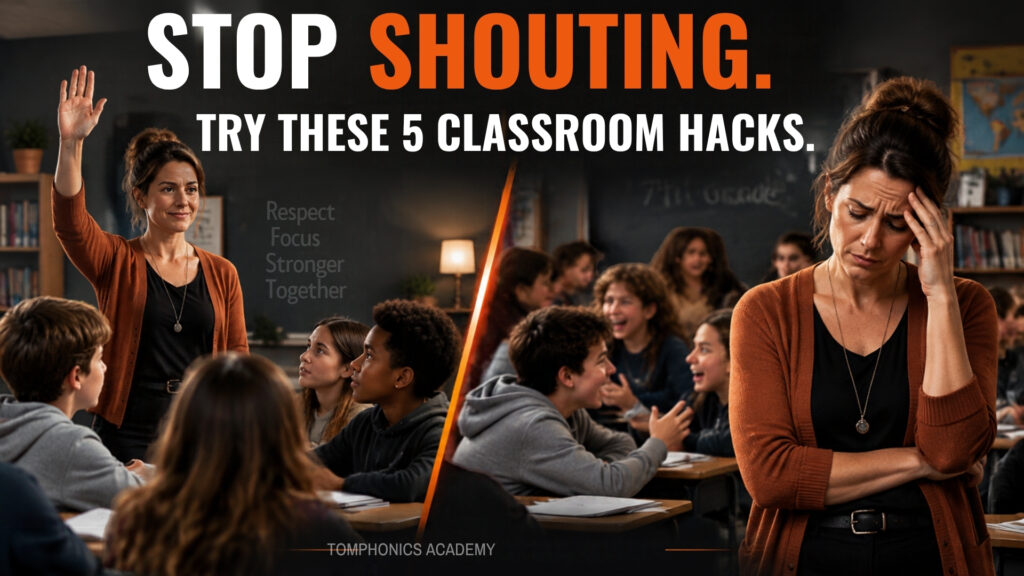
What teachers can learn about classroom noise from routines, anticipation, transitions, and the psychology of attention.
A teacher once described her classroom management problem in a sentence that many educators will recognize.
“My students only become quiet when I scream.”
I asked a question that changed the direction of our discussion.
“What happens after you stop screaming?”
She explained that the students usually became noisy again.
That is the problem with depending on volume.
Shouting may interrupt behavior temporarily, but it does not automatically teach students what they should do when the shouting ends.
A class that becomes quiet only when the teacher becomes angry may be responding to emotional intensity rather than an established classroom routine.
The solution is not to expect every classroom to remain completely silent.
Students need appropriate opportunities to discuss, collaborate, move, question, and participate.
The goal is to make the difference between productive discussion and disruptive noise understandable.
Here are five unusual strategies that can help.
1. The Doorway Bouncer Hack: Manage the First Thirty Seconds
Imagine standing outside a seventh-grade classroom just after lunch.
Students are discussing weekend plans, sporting events, friendships, and arguments from earlier in the day.
They enter the room still talking.
Some walk toward their desks.
Others wander toward friends.
A few stand beside the windows.
The teacher waits for everyone to settle.
But there is no clear activity waiting.
Those first moments create an opening for noise.
Why the classroom entrance matters
Transitions require students to stop one activity and begin another.
Without a predictable routine, the switch can take longer than necessary.
Students may continue whatever behavior was appropriate in the previous environment.
This is why the classroom doorway can become a useful management point.
Not because teachers should act like security guards.
Because a consistent entry routine establishes the purpose of the next few minutes.
What to do
Stand where you can appropriately greet students.
Provide a brief, friendly acknowledgment.
Direct them toward a visible opening task.
For example:
“Good afternoon. Your opening question is on the board.”
“Welcome back. Collect your materials and begin the warm-up.”
“Come in, take your seat, and write one sentence about yesterday’s reading.”
Have the necessary resources ready.
The first task should be accessible enough for students to begin independently.
The psychology
Predictability reduces uncertainty.
A structured entry also limits the unoccupied time in which unnecessary conversation can spread.
Greeting students can support positive relationships while communicating that learning begins promptly.
Avoid turning entry routines into public confrontations. Students who arrive upset, late, or needing support may require individual responses.
The hack: Stop treating the first thirty seconds as dead time. They are part of classroom management.
2. The Teacher GPS Hack: Give Students an Instruction Map
A student asks, “What are we supposed to do?”
You explain.
Another student asks the same question.
You explain again.
Someone at the back raises a hand.
“Are we writing the answers?”
You answer.
A fourth student asks what happens after finishing.
Now you are repeating instructions instead of supporting learning.
This is particularly frustrating when you believe the directions were already clear.
But clarity is not measured only by whether the teacher said the words.
It is measured by whether students know what action to take.
The psychology of instruction overload
Students cannot always retain several spoken directions while also managing materials, distractions, and the demands of the task.
Working memory limitations are especially relevant when tasks are unfamiliar.
A visual instruction map gives students a reference they can return to.
The strategy
Display three short sections:
START HERE: Read paragraphs one through three.
DO THIS: Identify the main argument and two supporting details.
FINISH HERE: Write a four-sentence explanation and submit your response.
Explain the sequence.
Model the starting point when necessary.
Then ask a student to explain what the class should do.
This checks understanding before independent work begins.
A real classroom application
During group work, give each group a card that explains the sequence of activities.
For example:
Read the problem.
Discuss possible solutions.
Agree on an explanation.
Record the group’s reasoning.
Prepare one person to share.
Students who become confused can return to the instructions instead of repeatedly calling for help.
Of course, posted directions do not remove the need to support students with reading, language, or processing difficulties.
The hack: Do not expect students to navigate an assignment when you have given them a destination without a route.
3. The Whisper Trap: Stop Attempting to Outshout Thirty Voices
The class is noisy.
The teacher says, “Quiet down.”
Several students continue talking.
The teacher repeats the instruction, this time louder.
Some students stop.
Others do not.
The teacher raises her voice again.
Eventually, the room becomes quiet.
But a few minutes later, the process repeats.
The teacher is working harder each time.
The students are learning that the first request may not require a response.
The psychology of attention signals
An effective attention signal works because its meaning has been explicitly taught and practiced.
It communicates a predictable transition.
Students know when to finish a conversation, stop an activity, and redirect their attention.
It does not need to be loud.
It needs to be recognizable and consistently implemented.
The strategy
Choose a signal appropriate for the students’ age and accessibility needs.
Explain exactly what students should do when they notice it.
For example:
“When I raise my hand, finish your sentence, stop the activity, and redirect your attention toward the instructions.”
Demonstrate the expected response.
Then allow students to practice during a low-pressure activity.
Have students discuss a question briefly.
Give the signal.
Observe the response.
Provide specific feedback.
“Most of you finished your conversations and redirected your attention quickly. Let’s practice again so everyone knows the routine.”
Repeat as needed.
Avoid expecting perfect compliance after a single demonstration.
What not to do
Do not introduce a new signal in the middle of a serious confrontation.
Do not interpret every delayed response as deliberate disrespect.
Some students need additional processing time or adapted signals.
And do not use an attention routine to demand silence during activities where appropriate discussion is expected.
The hack: Teach students how to respond to your normal voice before frustration makes your loudest voice the classroom’s main instruction system.
4. The Traffic-Light Mouth Hack: Give Classroom Noise a Purpose
Some teachers attempt to manage every classroom activity with the same instruction.
“Be quiet.”
But silence is not appropriate for every learning task.
Imagine a teacher asking students to discuss a controversial historical decision and then becoming frustrated when they begin speaking.
The issue is not that students are talking.
The issue may be that expectations for the discussion were never established.
Understanding purposeful noise
Classroom communication serves different purposes.
Students may need silence to complete an independent assessment.
They may need quiet conversation to compare ideas with a partner.
They may need energetic but organized discussion during a collaborative project.
The teacher’s responsibility is to clarify the expectations for each situation.
The strategy
Introduce three classroom communication levels.
RED — Independent work: No conversation unless help is required.
YELLOW — Partner discussion: Quiet conversation with an assigned partner.
GREEN — Group collaboration: Structured discussion within the group, with everyone able to work productively.
Display the level that applies.
Explain what students should be doing at that level.
Practice transitions between levels.
For example:
“You have two minutes at Yellow Level to compare your answers.”
Then use your attention signal.
“We’re moving to Red Level while everyone completes the reflection.”
The psychology
Students are better able to adjust behavior when expectations match the specific task.
Clear boundaries reduce the need for the teacher to continuously decide whether every conversation is acceptable.
But do not turn the system into rigid control of every sound. Students with communication differences and individual support needs may require adaptations.
The hack: Sometimes the classroom does not need less talking. It needs clearer rules about when talking helps learning.
5. The Last-Five-Minutes Heist: Stop Letting the Bell Steal Your Lesson
It is 2:35 p.m.
Your lesson ends at 2:40.
You are explaining the final example.
Suddenly, a zipper opens.
Then another.
Someone starts putting books away.
A student asks whether homework is due tomorrow.
Two students stand beside their desks.
The lesson has not ended, but the class has already begun leaving psychologically.
Why this happens
Students anticipate transitions.
If the last part of a lesson is unpredictable, they may begin preparing for departure before instruction is complete.
A structured closing routine gives those final minutes a purpose.
The strategy
Set aside a brief closing sequence.
First, ask one question that checks the central learning objective.
Second, explain the next step or homework requirement.
Third, provide time to organize materials.
Fourth, dismiss students according to school procedures.
For example:
“Before we leave, write one sentence explaining the difference between a claim and evidence.”
After students respond, give the packing instruction.
This allows students to anticipate the transition without taking over its timing.
The psychology
Predictable routines help students manage transitions and reduce uncertainty.
A meaningful closing task also encourages students to mentally revisit what they learned.
The purpose is not to keep students busy unnecessarily until the bell.
It is to make the end of the lesson intentional.
The hack: If your students are already packing five minutes early, design a final five minutes worth staying for.
What Actually Makes a Classroom Quieter?
There is an uncomfortable reality behind classroom noise.
Sometimes students are talking because they want attention.
Sometimes they are avoiding work.
Sometimes they have unfinished social conversations.
But sometimes they are talking because they do not know what to do, how long an activity should last, or what happens next.
That is why effective classroom management must go beyond telling students to stop talking.
Teachers need to examine the environment surrounding the behavior.
Do lessons begin predictably?
Are instructions accessible?
Do students know the attention signal?
Are discussion expectations clear?
Do transitions have a routine?
These questions often reveal practical opportunities for improvement.
A Five-Day Classroom Noise Experiment
For one school week, introduce one improvement at a time.
On Monday, strengthen the entry routine.
On Tuesday, improve how instructions are displayed.
On Wednesday, explicitly practice an attention signal.
On Thursday, establish communication expectations for different activities.
On Friday, structure the final minutes of instruction.
Record which changes appear to improve transitions and engagement.
Remember that a single week is an initial experiment, not proof of lasting change.
Students may require longer practice, individualized support, or additional interventions.
The goal is to create a classroom where purposeful participation becomes easier and unnecessary noise becomes less dominant.
Keep Reading
- How to Quiet a Noisy Classroom Without Raising Your Voice
- “Do You Have Any Food?” and the Other Daily Student Questions That Drain You. Answer Them Once.
- Your Classroom Rules Are Fine. How You Introduce Them Is the Problem.
Want to Stop Depending on Shouting to Get Students’ Attention?
The language you use when giving instructions, correcting behavior, and redirecting students matters.
My book, The Language of Classroom Authority, is for educators who want to examine how their classroom communication can become clearer, calmer, and more consistent.
Get your copy here:
Tomphonics Academy — Better routines. Clearer communication. Stronger classrooms.
How did this land?
Tap a reaction. It helps us write more of what teachers need.




Join the conversation
No comments yet. Be the first to share how this works in your classroom.