Why power struggles start in the classroom, and how the calmest teachers end them without losing authority
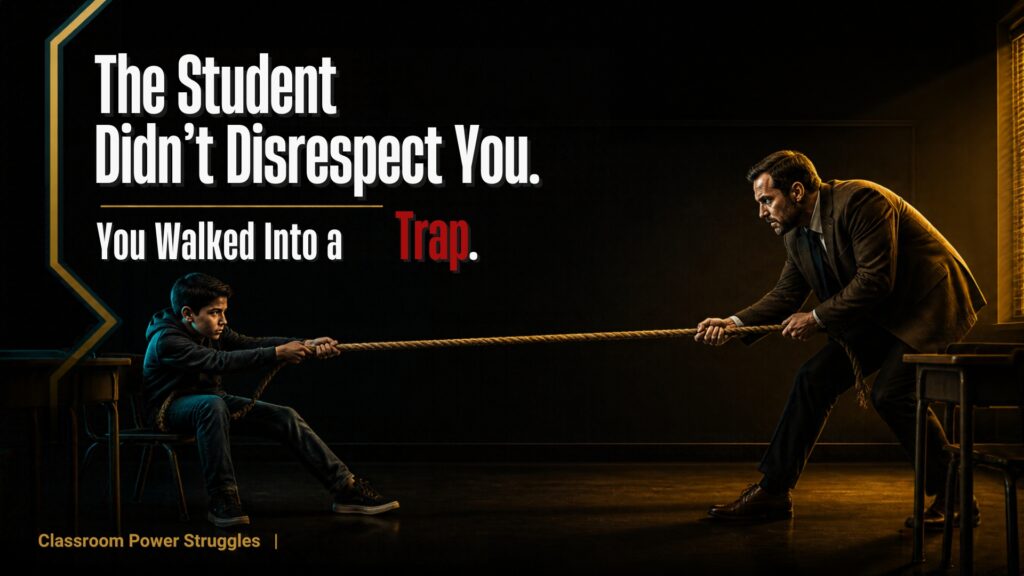
Every teacher knows the moment.
You give a simple instruction. A student refuses. The room goes quiet. Thirty pairs of eyes swing between you and the student, waiting to see who blinks first.
Your pulse quickens. A voice in your head says, I can’t let them win this.
That voice is the trap.
Power struggles are among the most draining experiences in teaching. They eat into instructional time, damage relationships, and leave teachers feeling defeated even when they “win.” Most of them are not caused by bad students or weak teachers. They are caused by predictable psychological patterns that, once understood, can be stopped before they begin.
Here is the truth that changes everything: authority isn’t won in the argument. It’s lost the moment you step into it.
What a Power Struggle Really Is
A power struggle is not a discipline problem. It is a contest.
It requires two players. The student brings the fuel: defiance, resistance, a refusal to comply. The teacher brings the fire: escalation, ultimatums, raised voices, the need to have the final word.
Remove either one, and the struggle starves.
Since the teacher is the adult in the room, the professional, and the one responsible for the learning environment, the teacher holds the power to end it. Not by overpowering the student, but by refusing to play.
To do that well, you first need to understand why these struggles start.
Why Power Struggles Start
The Audience Effect
Behaviour gets louder when peers are watching.
When a student pushes back in front of the class, they are rarely fighting you. They are performing for the room. Their reputation, their social standing, and their sense of self are all on the line.
Backing down in public costs them something real. So they dig in. Not because they want to defy you, but because the audience has made retreat feel impossible.
The Cornered Response
Ultimatums feel powerful. “Do it now, or you’re going to the office.” “One more word and you’re out.”
But ultimatums remove every exit. They leave the student with two options: total surrender or total resistance.
Psychologists call the result reactance. First described by psychologist Jack Brehm, reactance is the natural human impulse to push back when we feel our freedom is being threatened. When people sense that control is being taken from them, they act to reclaim it, even when doing so works against their own interests.
The harder you push, the harder they push back. Not because they are difficult, but because they are human.
The Hidden Need
Defiance is often a disguise.
The student who refuses to start the assignment may not understand it and would rather look defiant than look lost. The student who snaps at you may have arrived hungry, exhausted, or carrying something heavy from home. The student who argues every instruction may be craving the attention they cannot get any other way.
The behaviour is the smoke. The need is the fire.
Respond only to the smoke, and the fire keeps burning.
The Teacher’s Ego Hook
This one is the hardest to admit.
The moment a teacher thinks, I can’t let them win, the conflict stops being about learning and becomes about status. Now there are two people defending their pride in front of an audience, and only one of them is paid to be the adult.
Teachers are human. Feeling challenged is natural. But acting from wounded pride turns a small moment into a lasting battle.
The Hidden Cost of “Winning”
Many teachers believe that if they back down, they lose authority. So they escalate until the student submits.
But consider what that victory actually buys.
The student complies, but resents you. The relationship is damaged. The rest of the class learns that conflict with you is loud and public. And the same student returns tomorrow, ready for a rematch, because nothing about the underlying cause has changed.
You won the battle. You lost the classroom.
True authority is not the ability to force compliance. It is the ability to maintain a calm, structured environment where students choose to cooperate. That kind of authority is built through steadiness, not volume.
The 4R Exit Protocol: How to End a Power Struggle Without Losing Authority
The following framework gives teachers a clear, repeatable process for stepping out of a struggle while keeping standards firm.
Read
Before you respond, diagnose.
Take a breath and ask yourself: what is driving this? Is the student performing for an audience? Do they feel cornered? Is there a need hiding beneath the behaviour?
Ten seconds of diagnosis can save ten minutes of conflict. The goal is to respond to the cause, not react to the surface.
Remove the Audience
Take the conversation private.
Lower your voice. Move closer to the student rather than calling across the room. Kneel or crouch to their eye level if appropriate. If needed, quietly ask them to step outside for a moment.
When the crowd disappears, so does the performance. Most students become far more reasonable when they no longer have to protect their image in front of their peers.
Return Control
Offer a bounded choice.
Instead of “Start your work now,” try: “Would you like to begin with question one or question three? Your call.” Instead of “Sit down,” try: “You can sit at your desk or at the table by the window. Which works better for you?”
Both options lead to the outcome you want. But the student gets to choose, which restores their sense of autonomy and dissolves the reactance that fuels resistance.
Your standard stays intact. Only the path becomes flexible.
Repair
Reconnect once the moment has passed.
Later in the day, find two minutes for a calm, private conversation. Acknowledge what happened without lecturing. Ask what was going on. Make it clear that the relationship is intact.
“Earlier was tough. I’m not upset with you. I want to understand what was happening so we can make tomorrow easier.”
Repair is the step most teachers skip, and it is the step that prevents the rematch. A student who feels respected after a conflict is far less likely to start the next one.
What Calm Authority Sounds Like
Small changes in language create large changes in outcome. A few shifts worth practising:
Instead of “Don’t talk to me like that,” try “I can see you’re frustrated. Let’s talk about it in a minute.”
Instead of “You’re going to the office if you don’t stop,” try “I need you ready to learn. What would help you get there?”
Instead of “Because I said so,” try “Here’s why this matters for what we’re doing next.”
Instead of arguing in front of the class, try “Let’s finish this conversation privately after the lesson.”
Each of these responses keeps your expectations clear while removing the fuel that keeps a struggle alive.
A Note for School Leaders
Power struggles are not only an individual teacher’s challenge. They are a school culture issue.
When staff share a common de-escalation language and a consistent protocol, students experience predictability across every classroom. Teachers feel supported rather than isolated. And the school builds a reputation for calm, confident leadership that parents notice and trust.
Training staff in frameworks like the 4R Exit Protocol is one of the most practical investments a school can make in both teacher wellbeing and student outcomes.
The Bottom Line
Power struggles are not a test of who is stronger. They are a test of who stays steady.
The student brings the fuel. You decide whether to bring the fire.
Read the moment. Remove the audience. Return control. Repair the relationship.
Authority isn’t volume. It’s the calm that makes volume unnecessary.
Take Action
The next time you feel a power struggle beginning, pause and ask yourself one question: What does this student need right now? Then run the 4Rs.
If this article helped you see classroom conflict differently, share it with a colleague who is still fighting battles they don’t need to win.
Keep Reading
- How to Build Calm Authority Without Becoming an Angry Teacher
- The Psychology Behind Classroom Power Struggles and How to Defuse Them
- “Do You Have Any Food?” and the Other Daily Student Questions That Drain You. Answer Them Once.
How did this land?
Tap a reaction. It helps us write more of what teachers need.




Join the conversation
No comments yet. Be the first to share how this works in your classroom.