Friday Afternoon Chaos Starts With Something You Stopped Doing on Wednesday.
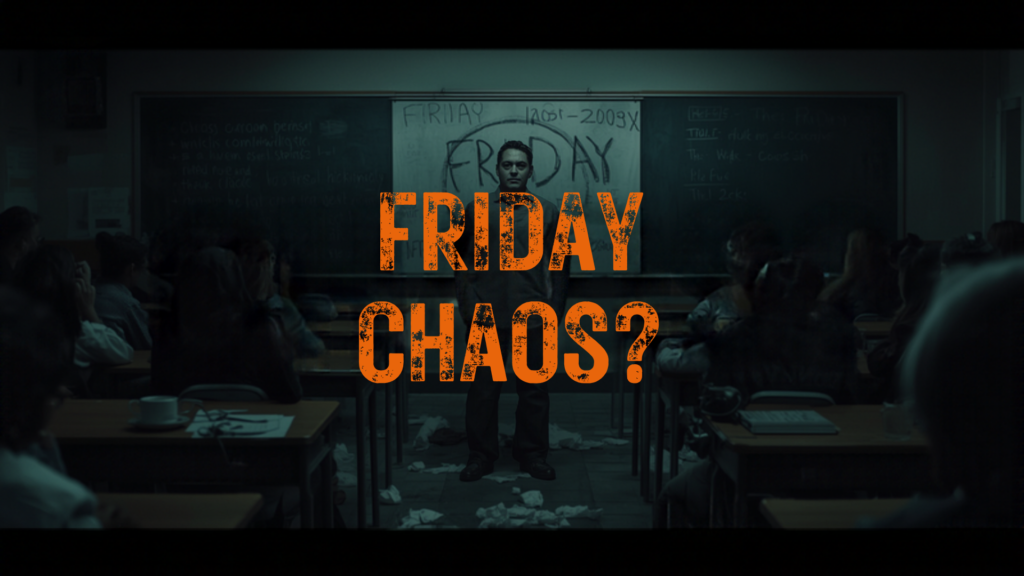
Friday afternoon. The class is louder, slower and harder to settle than any other time of the week. Most teachers blame tiredness. But the chaos usually starts days earlier, with something small you stopped doing around Wednesday.
It’s the last lesson on Friday. You can feel it before they arrive. Chairs scrape. Bags stay on desks. Someone is already asking if you’re “doing anything fun”. You start the lesson and get about four minutes of attention before the room drifts into weekend mode.
Every teacher knows the Friday feeling, in every country and every school. And most of us explain it the same way: everyone’s tired, it’s the end of the week, what do you expect?
Tiredness is part of it. But if you look closely at what happens across a week, you’ll often find something else. On Monday, routines are sharp. By Wednesday, you’re tired too, and small things start to slide: you don’t greet at the door because you’re finishing an email; you let one late arrival go; you skip the Do Now because the projector is slow; you give the instruction once more over the noise instead of waiting. Each slip is tiny. By Friday, the class has learned that the routines are optional this late in the week.
This article is for teachers who dread Friday afternoons. You’ll learn the midweek slide that creates Friday chaos, how to spot it, the routines to protect, a Friday lesson structure that works with students’ energy, and a five-minute reset for when it all goes wrong.
1. The Midweek Slide
Why this happens
Teaching is exhausting. By Wednesday most teachers are running on less sleep, more grading and fewer reserves. When you’re tired, you naturally drop the things that take effort: standing at the door, waiting for silence, following up on small behavior, preparing the starter.
Students notice immediately. They don’t think, “Our teacher is tired.” They think, “Those rules don’t apply today.” And they carry that into Thursday and Friday.
The usual first things to slip
- The door greeting. You’re finishing something at your desk as they arrive.
- The Do Now. It’s not ready, so students wait.
- Waiting for silence. You talk over a little noise “just this once”.
- Small follow-ups. A late arrival, a missing pen, a rude comment you let pass.
- The end of the lesson. No proper packing-away routine; students leave in a rush.
What not to do
Don’t blame yourself for being tired. Blame the system for needing more energy than you have. Then make the system easier to run.
2. Spot Your Own Slide
The strategy: the routine tracker
For one week, keep a tiny tally on a sticky note for one class. After each lesson, tick whether you did each of these:
- Greeted at the door.
- Do Now ready on arrival.
- Waited for silence before instructions.
- Followed up on every small behavior.
- Closed the lesson with a routine.
By Friday, you’ll see exactly which routines slipped and when. Most teachers are surprised to find the slide starts on Tuesday or Wednesday, not Friday.
3. Protect the Big Three
You can’t run every routine perfectly all week. So protect the three that matter most, and make them as easy as possible.
Routine 1: The threshold
Stand at the door for the first minute of every lesson, no matter what. Greet, direct, watch phones go away. This one routine signals that the lesson has started and you’re in charge of it.
Make it easier: Have your Do Now ready from the morning, so you’re not finishing it as students arrive.
Routine 2: Silence before instructions
Use your attention signal and wait. Every time. Even on Friday. Especially on Friday.
Make it easier: Use a non-verbal signal (a raised hand, a countdown on the board) so you’re not raising your voice when you’re tired.
Routine 3: A closed ending
The last three minutes: an exit question, chairs tucked in, a calm dismissal by table. Students carry how a lesson ends into the next one.
Make it easier: Use the same exit routine every lesson, so it runs without planning.
Say this
- “Same as every day: door, task, silence. Friday doesn’t change the routine.”
- “I’ll wait. We’ve got all the time in the world.”
- “Table one, chairs in, off you go. Have a good weekend.”
4. Plan Fridays to Work With Energy, Not Against It
Why this matters
Even with perfect routines, Friday afternoon students have less focus. Fighting that with your longest explanation of the week rarely works. Work with it instead.
The strategy: the Friday structure
- Short, active starter (5 minutes): a quiz, a puzzle, a quick-fire retrieval game.
- Short explanation (8–10 minutes): one key idea, not three.
- Structured, active practice (20–25 minutes): something with movement, talk or competition, such as stations, a timed challenge, a partner task with clear roles.
- Retrieval round-up (5–10 minutes): review the week’s key learning. It’s a perfect Friday job, because it strengthens memory and gives students a sense of progress.
- Calm close (3 minutes): exit question, tidy, dismissal.
What to avoid on Friday afternoons
- New, complex content that needs long concentration.
- Long silent writing tasks with no breaks.
- Videos or “free time” as a reward. Unstructured time is where Friday chaos lives.
A real classroom example
A secondary science teacher used to plan her heaviest theory lesson for Friday period five, because that’s when the schedule put it. It was chaos every week. She switched the order: theory on Wednesday, practice and retrieval on Friday. Friday became a weekly “challenge lesson” with timed team quizzes and a short practical task. Behavior on Fridays improved noticeably within two weeks, and her students’ end-of-unit scores went up, because the Friday retrieval was doing real work.
5. The Five-Minute Reset (When Friday Gets Away From You)
Sometimes, even with all of the above, a lesson goes off the rails. You don’t need to shout. You need to reset.
The strategy
- Stop everything. Use your attention signal and wait in total silence. As long as it takes.
- Name it calmly. “This isn’t how we work in here. We’re going to reset.”
- Restart with something easy. “Everyone, write the date and title. Thirty seconds.” A simple, certain task gets everyone doing the same thing again.
- Give one clear instruction for what happens next.
- Move, notice, reconnect. Walk the room. Quietly thank students who are working. Have a word with the one or two who started it.
Say this
- “Stop. Pens down. Eyes here.” (Then silence.)
- “We’ve drifted. That’s okay, it happens. We’re going to restart now.”
- “You’ve got thirty seconds to write the title. Go.”
- “Thank you, Lina. Thank you, back table.”
What not to do
- Don’t punish the whole class. It turns the room against you.
- Don’t give a long speech about respect. Keep it short and move on.
6. Look After Your Own Friday Energy
The strategy
- Plan Friday lessons on Monday or Tuesday, when you have more energy, not on Thursday night.
- Keep Friday resources simple. Retrieval quizzes and practice tasks you can reuse.
- Protect your lunch break on Friday. Ten minutes away from your desk makes the afternoon easier.
- End the week on purpose. Write down one good thing from the week before you leave.
For a deeper look at routines that hold all week, read classroom management is a system and 5 unusual ways to manage a noisy classroom without shouting.
7. Make It a Team Habit, Not a Solo Fight
One teacher holding firm on a Friday afternoon helps their own room. When a whole year team or department holds the same line, the slide slows down across the school. Students notice quickly when expectations change from one classroom to the next, and the end of the week is when they test that hardest.
Agree your Friday non-negotiables
At your next team meeting, take ten minutes to agree on three routines every teacher will keep running all week, including Friday afternoon. Keep them simple and visible.
- The entry routine: students come in, sit down and start the task on the board within one minute.
- The attention signal: one signal, used the same way in every room.
- The exit routine: chairs tucked, area tidy, dismissal by the teacher, not the bell.
Write them on one page and display them in every classroom. When a student says “Mr Okafor lets us pack up early”, every teacher can reply honestly, “Not this week, he doesn’t.”
Use a midweek check-in
Burnout and slippage show up in staff before they show up in students. Spend five minutes in a Wednesday briefing asking one question: “Which routine is slipping in your rooms this week?” Hearing that others are struggling with the same thing removes the shame, and colleagues often share fixes on the spot.
Share the Friday load
Some teams rotate a “Friday support” role. One colleague with a free period on Friday afternoon spends ten minutes walking the corridor, popping into classrooms and helping with any student who needs to step out. Knowing support is nearby makes teachers more confident about holding expectations, rather than letting things slide to avoid a fight.
Plan one shared Friday activity
Consider a short, structured activity that every class in the year group does at the same time on Friday, such as a ten-minute weekly quiz, a reading block or a reflection on the week’s learning. Shared routines reduce the planning load for each teacher and create a predictable rhythm students come to expect, even enjoy.
Ask leaders for structural help
Some Friday chaos comes from things only leaders can change: assemblies that overrun, schedules that put the hardest classes in the last period, or events that drain energy just before the weekend. Collect evidence for two or three weeks, such as the number of incidents by period and day, and present it calmly.
Say this: “We’ve tracked behavior for three weeks. Most incidents happen in period five on Fridays. Could we look at what’s scheduled there?”
Evidence turns a complaint into a solution leaders can act on.
Celebrate the wins together
When the team holds firm and Fridays improve, say so. Share it in a staff briefing, a quick message or a note in the teachers’ lounge. Teachers rarely hear that their consistency made a difference, and that recognition is what keeps everyone holding the line in the long run.
What Actually Fixes Friday Chaos
- Friday chaos often starts midweek, when small routines slip.
- Track your routines for one week to see where the slide starts.
- Protect the big three: the threshold, silence before instructions, a closed ending.
- Plan Fridays for energy: short explanations, active practice, retrieval.
- Use the five-minute reset instead of shouting when it gets away from you.
Try This Tomorrow
- Put a five-tick routine tracker on a sticky note for one class this week.
- Prepare your Do Now the day before so you can stand at the door.
- Use a non-verbal attention signal, and wait for silence every time.
- Plan next Friday’s lesson around retrieval and active practice.
- Practice the five-minute reset script so it’s ready when you need it.
Keep Reading
- “Do You Have Any Food?” and the Other Daily Student Questions That Drain You. Answer Them Once.
- Your Classroom Rules Are Fine. How You Introduce Them Is the Problem.
- Group Work Keeps Turning Into One Student Working While Four Watch. Here’s the Structure That Ends It.
Frequently Asked Questions
Why are students so badly behaved on Friday afternoons?
Tiredness plays a part, but Friday chaos often grows from small routines slipping earlier in the week. When greetings, silence before instructions and follow-ups drop midweek, students learn the rules are looser, and Friday shows the result.
How do I manage a class on a Friday afternoon?
Keep your core routines exactly the same as Monday, plan shorter explanations with active, structured practice, use retrieval of the week’s learning, and close the lesson with a calm, consistent routine.
What should I teach on a Friday afternoon?
Short explanations and active practice work best: retrieval quizzes, timed challenges, stations and partner tasks. Avoid new complex content that needs long concentration and avoid unstructured free time.
How do I reset a lesson that’s out of control?
Stop the class with your attention signal, wait in silence, calmly name that you’re resetting, give a simple task everyone can do immediately, then give one clear instruction and quietly acknowledge students who are back on track.
Should I give free time on Fridays?
Unstructured free time often increases disruption. If you want a lighter lesson, use structured, enjoyable activities like team quizzes or challenges that still involve learning.
Want a Ready-Made Reset for Any Lesson That Slips?
Every teacher needs a plan for the moment a lesson gets away from them. The 5-Minute Classroom Reset is a free guide with the minute-by-minute reset, the exact scripts and five fixes to try tomorrow. Download The 5-Minute Classroom Reset free.
How did this land?
Tap a reaction. It helps us write more of what teachers need.






Join the conversation
No comments yet. Be the first to share how this works in your classroom.