Classroom Phone Bans Keep Failing. The Rule Was Never the Problem.
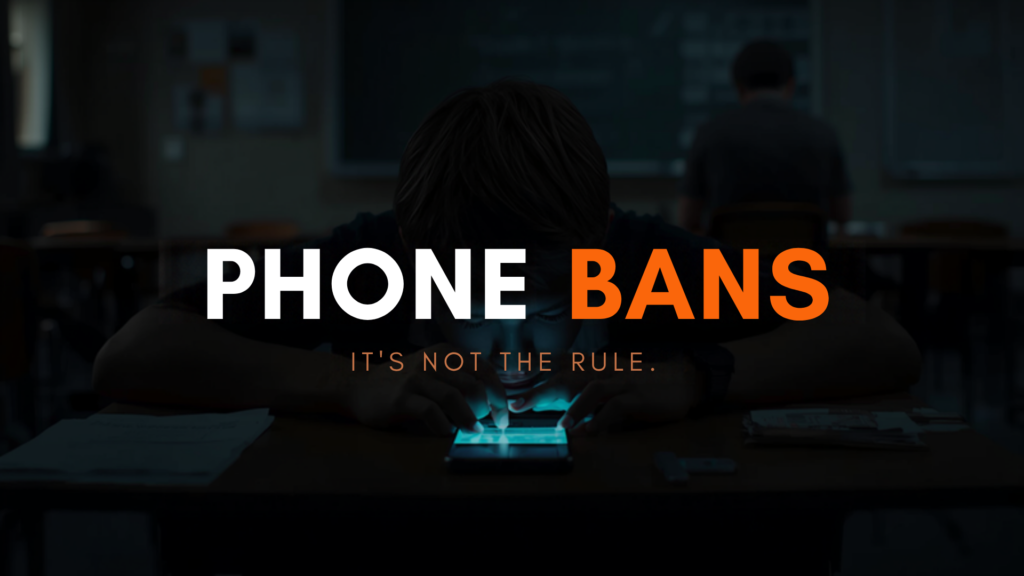
Schools everywhere are banning phones. Teachers are still catching them under desks, in pockets and in the toilets. The rule isn’t what’s failing. The system around it is.
The memo went out. Phones are banned in class. Parents signed the form. The poster went up by the door.
And on Tuesday, third period, you still see the glow under the desk.
You take it. The student argues. The lesson stops. Two other students film the argument on their phones. By Friday you’re spending more energy policing phones than teaching, and you’re wondering whether the ban was ever going to work.
You’re not imagining it. Teachers in many countries are reporting the same thing: the ban exists on paper, but in the room it’s left to individual teachers to enforce, often with no clear process and no backup. Students quickly learn which classrooms enforce it and which don’t. Some swap in a spare “burner” phone to hand over. Others ask for the toilet and spend ten minutes scrolling.
This article is for teachers and school leaders who want phones to stop eating lesson time. You’ll see why bans fail at classroom level, the system that makes them work, exact words to use when you catch a phone, and a plan for this week.
1. Why Phone Bans Fail in the Classroom
The rule asks one person to do a whole-school job
A phone ban is a whole-school decision delivered by individual teachers. When a school says “no phones” but leaves enforcement to each teacher, it creates thirty different versions of the rule. Students compare them. The strict teacher becomes the villain. The relaxed teacher becomes the norm. The ban quietly dies.
Confiscation creates a fight every time
Taking a phone from a teenager isn’t like taking a pen. For many students the phone holds their friends, their music and, honestly, their anxiety. Grabbing it in front of the class turns a rule into a public power struggle. Some schools also warn teachers about liability if a confiscated phone is lost or damaged, which makes teachers hesitate. Hesitation teaches students that the rule is negotiable.
The phone is often a symptom, not the cause
A student scrolling under the desk in the middle of a lesson is often telling you something: the task is too easy, too hard, too long, or unclear. Phones fill gaps. A lesson with no dead time has fewer gaps to fill.
What not to do
Don’t make your classroom the only place where the rule is real, without telling anyone. You’ll burn out, and students will resent you as the one teacher who “makes a big deal”. If the school’s system is weak, raise it (see section 5).
2. The System That Makes Phone Rules Work: Remove the Decision
The most reliable phone policies have one thing in common: they remove the moment of decision from the student and the moment of enforcement from the teacher.
The strategy: phones are away before the lesson starts
- Away at the door. Phones go in a bag, a locker, a pouch, a caddy or a numbered wall pocket before students sit down. The rule is enforced once, at the door, not thirty times during the lesson.
- Out of reach, not just out of sight. A phone on the desk face down still pulls attention. A phone in a backpack on the floor is better. A phone across the room is best.
- Same routine every lesson. If phones go away “most days”, students will test it every day.
Teachers who use a wall caddy by the door often describe the same thing: they greet students, watch the phone go in, and the problem simply stops appearing during the lesson.
Say this at the door
- “Morning. Phone in its pocket, then straight to your seat.”
- “Thanks. You’ll have it back the second the bell goes.”
- “I’ll hold the door while you pop it in.”
Short, friendly, routine. The message is: this is just what we do here, like taking your coat off.
Why this works
Willpower is a terrible strategy, for adults and for teenagers. Every time a phone vibrates, a student has to decide not to look. Over an hour, that’s dozens of tiny battles, and they lose some. Remove the phone and you remove the battles.
3. What to Do When You Catch a Phone Anyway
Even with a door routine, you’ll see a phone. How you respond in the next ten seconds decides whether this becomes a two-second fix or a ten-minute fight.
The strategy: private, calm, predictable
- Don’t stop the lesson. Keep teaching while you walk over.
- Get close and lower your voice. Crouch to the student’s level if you can.
- Give a choice that leads to the same place. “Bag or caddy, your choice.”
- Walk away. Give them a few seconds to comply without an audience watching.
- Follow up after class, not during.
Say this
- “Phone in your bag or in the caddy. Your choice. Thanks.” (Then walk away.)
- “I need it out of sight for the rest of the lesson. Bag’s fine.”
- If they refuse: “Okay. We’ll sort it at the end of the lesson.” (Then follow your school process. Don’t argue in front of the class.)
What not to do
- Don’t grab the phone from their hand. It turns into a physical confrontation and a liability risk.
- Don’t read anything on the screen or comment on it publicly.
- Don’t make it a joke at their expense. Embarrassment creates a student who needs to win the next round.
For more on keeping these moments calm, see classroom consequences that actually change behavior.
4. Close the Gaps Where Phones Creep In
Phones show up wherever there’s dead time. Find those moments and fill them.
The strategy: audit your lesson for dead time
The usual danger zones:
- The first five minutes, while you take the register or fix the projector. Fix: a “Do Now” task on the board before students arrive.
- Transitions, between activities. Fix: a countdown and a clear instruction for what to do next.
- Early finishers. Fix: a standing extension task everyone knows, such as “If you finish, do the challenge question on the back wall.”
- The last five minutes. Fix: a quick exit question or a short retrieval quiz until the bell.
The toilet problem
Some students ask for the toilet to use their phone. You don’t need to accuse anyone. Just tighten the system: a sign-out sheet with times, one student out at a time, no toilet trips in the first and last ten minutes unless it’s urgent. Patterns become obvious quickly, and you can pass them on to the right person without a confrontation.
A real classroom example
A secondary science teacher noticed most phone sightings happened during practical work, while one group waited for equipment. She added a “waiting card” to every bench: three quick questions about the experiment. Groups that were waiting answered the card. Phone sightings during practicals dropped to almost nothing within two weeks, without a single new consequence.
5. What School Leaders Must Do for the Ban to Work
If you lead a school, the most useful thing you can do is take enforcement off individual teachers’ shoulders.
The strategy
- One system for everyone. Same storage, same timing, same consequence ladder, in every classroom.
- A backup route. When a student refuses, the teacher calls for support and returns to teaching. The teacher shouldn’t have to win the standoff alone.
- Tell families the why and the how. Explain the reason (attention, learning, wellbeing) and give parents a way to contact their child in an emergency, through the school office.
- Review the data. Track incidents for a month. If one area of the building has most of them, fix that area.
Teachers consistently say the same thing about phone bans: they work in the rooms where the whole system backs the teacher up, and fail in the rooms where it doesn’t.
6. Teach Students Why, Not Just What
Why this happens
Students accept rules they understand better than rules they’re simply given. Many teenagers will tell you they can “manage” their phone. Very few have tested it.
The strategy: run a one-lesson experiment
Ask students to estimate how many times they check their phone in an hour. Then run one lesson with phones away and ask them, at the end, how focused they felt and how much they finished compared with a normal lesson. You don’t need to win the argument. Let them notice the difference themselves. Some teachers repeat this mini-experiment once a term.
Say this
- “I’m not trying to take your phone away from your life. I’m protecting one hour of your attention.”
- “Adults struggle with this too. I keep mine in a drawer while I teach.”
That last line matters. Students notice when the rule applies to the adult as well.
What Actually Makes Phone Rules Work
- Remove the decision. Phones away at the door, out of reach, every lesson.
- Private, calm responses when you catch one: a choice, then walk away.
- Fill the dead time where phones creep in.
- Whole-school backup so teachers aren’t fighting alone.
- Explain the why and model it yourself.
If general noise and distraction are your bigger problem right now, read 5 unusual ways to manage a noisy classroom without shouting.
Try This Tomorrow
- Choose your phone home for the lesson: bag on the floor, box or wall caddy by the door.
- Greet every student at the door and watch the phone go away before they sit.
- Put a “Do Now” task on the board so the first five minutes have no gap.
- Practice your private script: “Bag or caddy, your choice. Thanks.” Then walk away.
- Note when phones appear this week. Fix the biggest dead-time zone first.
Keep Reading
- Your Classroom Rules Are Fine. How You Introduce Them Is the Problem.
- “Do You Have Any Food?” and the Other Daily Student Questions That Drain You. Answer Them Once.
- Friday Afternoon Chaos Starts With Something You Stopped Doing on Wednesday.
Frequently Asked Questions
Why do classroom phone bans fail?
Usually because enforcement is left to individual teachers with no shared system, confiscation turns into public power struggles, and lessons have dead time that phones fill. Bans work best when phones are put away before the lesson starts and the whole school backs teachers up.
Should teachers confiscate phones?
Only if your school policy says so and gives you a safe process. A calmer option is asking the student to put the phone in their bag or a classroom caddy, giving a choice, and following up privately after class.
What do I say when a student refuses to put their phone away?
Stay calm and private: “Okay. We’ll sort it at the end of the lesson.” Then follow your school’s process. Don’t argue in front of the class.
Where should students keep phones during class?
Out of reach is best: a bag on the floor, a locker, or a caddy by the door. A phone face down on the desk still competes for attention.
How do I stop students using phones in the toilet?
Use a sign-out sheet with times, allow one student out at a time, limit trips in the first and last ten minutes, and share patterns with the right staff member rather than confronting students.
Want a Complete System for a Calm, Focused Classroom?
Phones are just one battle. The Classroom Management Playbook gives you a full set of routines, scripts and systems for the moments that drain your energy, so you spend your time teaching, not policing. Get The Classroom Management Playbook here.
How did this land?
Tap a reaction. It helps us write more of what teachers need.





Join the conversation
No comments yet. Be the first to share how this works in your classroom.